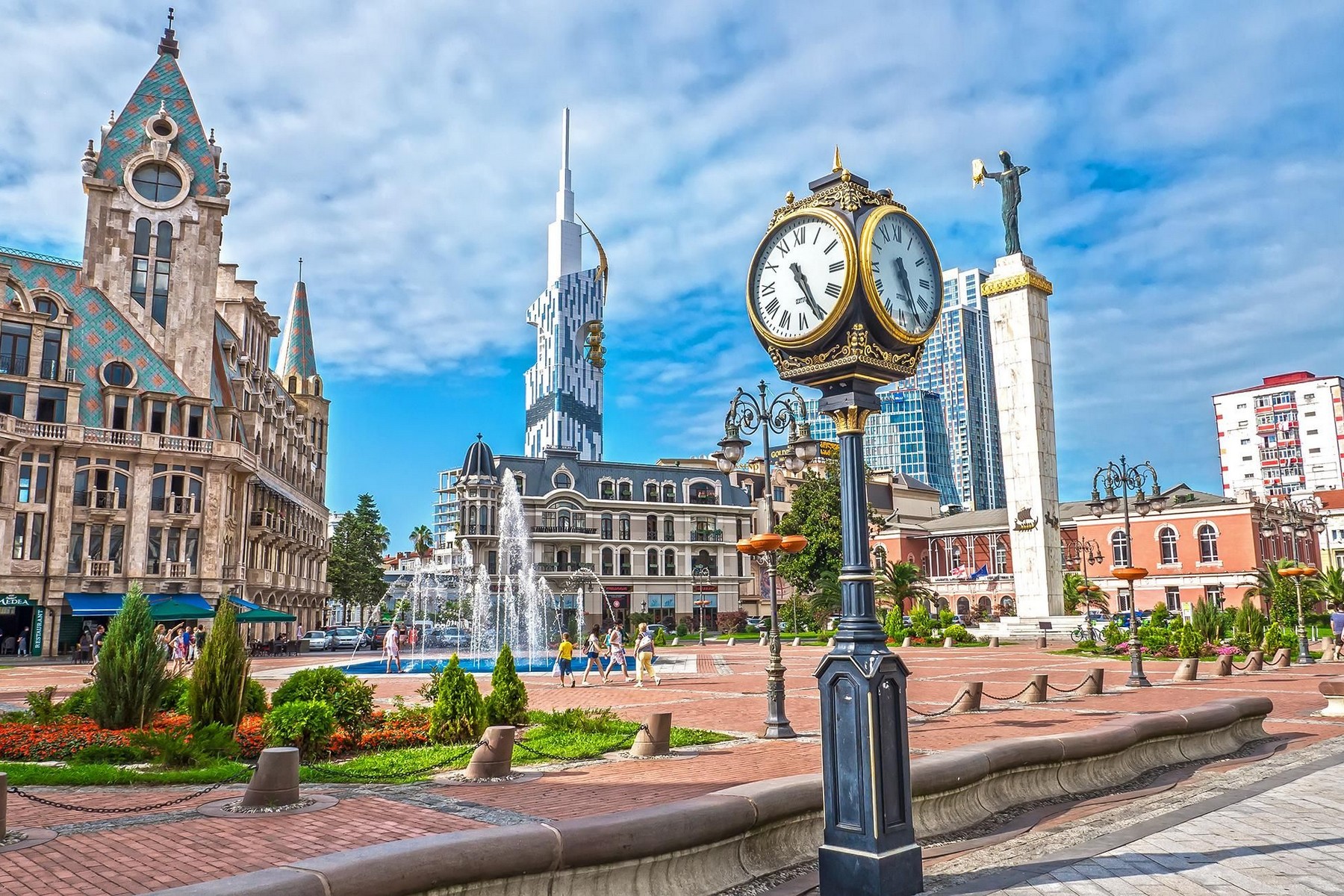
In September 2025 the Georgian government signed a term sheet with Eagle Hills for 6.5 billion USD across two masterplans. One of them lands on the coast just south of Batumi.
Eagle Hills is the Abu Dhabi developer founded and chaired by Mohamed Alabbar, the man who founded Emaar and built the Burj Khalifa. Eagle Hills is his own company rather than a division of Emaar, which is a distinction worth keeping straight, but the track record behind it is the same one.
That is a serious signal for a market this size. It is also not the whole story, and the parts nobody puts in a brochure are the parts that decide whether you make money.
What was actually signed
The term sheet was signed on 19 September 2025, during the UAE President's visit, between Eagle Hills and Georgia's Ministry of Economy and Sustainable Development. The 6.5 billion USD is the combined figure across both projects, not the amount going into either one:
| Tbilisi Waterfront | Riverside mixed-use at Krtsanisi, reported at around 590 hectares |
| Gonio Yachts & Marina | Beachfront and marina south of Batumi, reported at around 260 hectares |
| Georgian state stake | Reported at 33%, as co-owner |
| Combined investment | 6.5 billion USD |
Two notes on those numbers. The figure first reported in January 2025 was nearer 5.5 billion USD and was revised upward by the September term sheet, so older articles quoting the lower number are not wrong so much as out of date. And the hectare figures come from press coverage rather than the official release, which describes green zones and the preservation of migratory bird habitats along the Black Sea coast without publishing a quantified reserve.
A term sheet is also not a completed building. Eagle Hills has delivered at this scale before and has also attracted real controversy on projects elsewhere. Treat it as a strong signal of intent, not as a guarantee of what gets built or when.
What the price chart says
Batumi's average residential price per square meter was $838 in 2019 and still $844 in 2021. Then the curve bent.
- 2022: $897
- 2023: $1,125
- 2024: about $1,193
- 2025: $1,395, a 17 percent year on year jump, per TBC Capital
Primary market prices in June 2025 reached $1,427 per square meter (Colliers). On the seafront strip between Old Boulevard and New Boulevard, quality new build trades between $1,800 and $2,800.
Roughly 77 percent of apartments sold in Batumi in 2025 went to foreign buyers, per a Galt & Taggart developer survey. That is an unusually foreign-dominated coastal market, which cuts both ways: it means international demand is real, and it means local end-user demand is not what holds the floor up if sentiment turns.
How the off-plan spread works
Construction on a quality Batumi project runs 24 to 36 months. Between launch and handover, finished prices have typically risen 25 to 45 percent above the initial off-plan price, driven by construction cost inflation, phase-based price increases as units sell through, and general market drift.
A worked example. A 50 sqm studio entered at launch in early 2024 at roughly $1,050 per square meter costs $52,500. At handover in late 2026 at $1,450 per square meter, below today's average, it is worth $72,500. That is $20,000 of spread on a $52,500 entry over 30 months.
Past spreads are not a forecast. This one depends on the developer delivering on time and on the market not turning, and the section below is about what happens when it does.
The tax treatment
- Capital gains on residential property held under two years: 5 percent of the gain. Held over two years: zero
- No stamp duty, no additional dwelling surcharge, no SDLT equivalent. Registration costs $20 to $80
- Annual property tax is income-linked and capped at 1 percent of assessed value. Most foreign owners pay nothing
Against flipping in the UK, where a second property now attracts a 5 percent surcharge on top of standard stamp duty, the transaction friction is roughly a tenth. Our guide to why UK landlords are selling up covers what that comparison looks like from the British side.
Where this does not work
Most Batumi promoters skip this part.
Batumi carries genuine structural oversupply risk. Roughly 58,000 new apartments are scheduled for delivery between 2025 and 2029, and most are micro-studios built explicitly for short-term rental yield. A large share cluster in three zones: Novy Boulevard at around 22,400 units, Heroes Alley at around 12,000, and Makhinjauri at around 5,900.
If you buy a generic studio in a generic inland tower alongside twenty thousand near-identical units, you are not positioned for a flip. You are exit liquidity for the developer.
What has actually rewarded buyers is narrower:
Named developments with reputational skin in the game. A developer whose name is on the masterplan has more to lose from a bad delivery than one selling a single tower.
Seafront and near-seafront, where substitutability is capped. The strip between the boulevards is physically finite. Every inland tower makes genuine waterfront rarer.
Renovated older stock. Mostly ignored. Older flats appreciated 16.2 percent year on year in January 2025 (Colliers), faster than new build, because existing stock cannot expand.
And the risks that apply to the whole market regardless of which unit you pick: Georgia is a country of under four million people, so liquidity is thin and a hurried sale will cost you. You are earning lari in a market that quotes dollars while thinking in your home currency. And the country's long term political alignment is genuinely uncertain, which no one can price for you.
The demand side
More than 300 new hotels are scheduled to open in Georgia by 2028, adding around 18,800 rooms nationally, with Hilton Garden Inn Adjara and Wyndham Grand Batumi Gonio among the 2025 and 2026 openings. Batumi International Airport is expanding. The Adjara region welcomed 2.5 million visitors in 2024.
At national level, the IMF's July 2025 Article IV consultation put Georgian growth near 7 percent for 2025, easing to around 5 percent over the medium term. Public debt was about 36 percent of GDP in 2024 and below 35 percent in 2025, against roughly 100 percent for the UK.
Those are strong fundamentals. They are not a substitute for picking the right building.
Before you buy anything
Check the title yourself. Georgia's public registry records ownership, mortgages and seizures, it is open to anyone, and you do not need to be in the country to read it. Never accept a screenshot from a seller. Our title check guide explains the fields.
For off-plan specifically, what to check before buying off-plan covers developer land ownership, permits and payment structuring, and the scams foreign buyers fall for covers the rest. If you are choosing between the coast and the capital, Tbilisi vs Batumi compares them by buyer type, and the verified listings in Batumi show current pricing.
This article is general information, not investment, tax or legal advice. Price and market figures are drawn from published third-party research and are current as of 2026; past price growth is not a forecast. The Eagle Hills projects are at term sheet stage. Speak to a Georgian lawyer before committing funds.